2025 CONFERENCE

The 4th Annual Diversity in Healthcare Conference
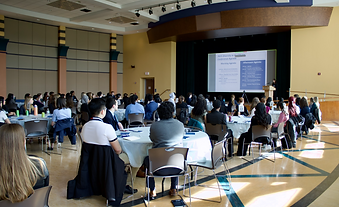
Held on March 23, 2025 at the Pennsylvania State University focused on exploring health communication. The intersection of diversity, equity, and inclusion within the healthcare system helps promoting strategies for improving healthcare access and outcomes for underrepresented groups.
Through case studies and speakers, participants had the opportunity to discuss about health communication and the many aspects of this that are fundamental quality healthcare, fostering understanding, trust, and equitable treatment across diverse patient populations.
Linguistic and Cultural Disparities
Examine how linguistic and cultural disparities hinder effective healthcare communication, often resulting in misunderstandings, reduced treatment adherence, and diminished trust between patients and providers.
Health Literacy and Patient Education
Low health literacy significantly impedes effective patient care, as limited understanding of medical information hinders informed decision-making and adherence to treatment, particularly among older adults and individuals with disabilities.

HEALTH COMMUNICATION: CONFERENCE THEMES
Digital Health and the Role of Technology
Digital health technologies—including telemedicine, mobile applications, and AI—are reshaping healthcare through enhanced communication, accessibility, and personalization; however, issues such as unequal access, limited digital literacy, and ethical considerations must be addressed to ensure equitable benefits.
Sensitive and Inclusive Language for Mental Health and LGBTQ+ Populations
Effective communication is essential for equitable care among marginalized populations, including those with mental health conditions, LGBTQ+ individuals, and other vulnerable groups. Using inclusive language and accessible communication fosters trust and improves health outcomes.
The conference promoted participants to gather what they have learned and come up with solutions surrounding health communication. The winners of the solutioning phase for 2025 will carry out their idea of easy-to-understand discharge papers in their local State College clinics.
Thank you to our speakers this year as they shared their expertise and vision for advancing equity and inclusion in medicine!
OUR SPEAKERS

Jennifer Kowalkowski
MPH, Ph.D., RN
Dr. Kowalkowski is an Assistant Professor in the Ross and Carol Nese College of Nursing at The Pennsylvania State University.
A population health nurse scientist, Dr. Kowalkowski’s research lies at the intersection of the social and health sciences, with a particular emphasis on understanding how sociocultural contexts influence the health and well-being of rural populations. Her work seeks to elucidate the complex relationships between social determinants of health and health outcomes in rural communities.
Dr. Kowalkowski conducts community-based research in rural settings to identify the facilitators and barriers that shape access to health resources and services. Through this work, she aims to inform interventions and policies that promote health equity and improve population health in underserved areas.
She began her career as a registered nurse before earning master’s degrees in Nursing and Public Health, followed by a Ph.D. in Nursing from the University of Wisconsin–Madison in 2021. Prior to her current appointment, she completed a postdoctoral fellowship in the Department of Biobehavioral Health at Penn State.

Jessica Gall Myrick
MPH, Ph.D.
Dr. Myrick currently serves as a Senior Clinical Scientist at Cook Research Incorporated, where she contributes to the Medical Vascular Division. In this role, she supports the development of innovative medical products designed to advance patient care and improve treatment outcomes.
Dr. Myrick earned her Ph.D. in Mass Communication and a Certificate in Interdisciplinary Health Communication from the University of North Carolina at Chapel Hill in 2013. Following her doctoral work, she joined Indiana University as an Assistant Professor from 2013 to 2017, and later served as a Professor at The Pennsylvania State University before transitioning into her current position.
With over 16 years of professional experience, Dr. Myrick has developed extensive expertise in research design, data analysis and interpretation, and communicating scientific findings to diverse audiences.
Her interests lie in the role of emotions in shaping public responses to health, science, and environmental issues. In particular, she examined how emotional and media-based approaches can be leveraged to promote public health and environmental well-being while at Penn State
To all who made this possible...
Thank you to the participants from Penn State Greater Allegheny, Altoona, York, World Campus, Harrisburg, Abbington, University Park!
Thank you to the sponsors of the 2025 conference!
